


Commercial irrigation system maintenance is the scheduled set of inspections, calibrations, repairs, and upgrades that keep large-scale landscape watering systems operating efficiently and reliably. Regular maintenance reduces water waste, ensures uniform coverage across different planting zones, prevents costly emergency repairs, and extends component lifespan—delivering measurable savings in both utility bills and maintenance budgets. This guide explains what components to monitor, how seasonal startup and winterization procedures protect assets, common failure modes and step-by-step troubleshooting, and how smart controls and conservation strategies lower long-term costs. Readers will find practical spring and winter checklists, diagnostic flows for leaks and controller faults, tables comparing component failure modes and recommended inspection cadences, and cost-driver breakdowns to inform budgeting and upgrade decisions. By following these evidence-based tips and decision frameworks, property managers and facilities teams can optimize irrigation performance, meet regulatory backflow and safety obligations, and plan ROI-driven upgrades that conserve water while maintaining landscape health.
Why Is Commercial Irrigation Maintenance Crucial for Your Property?
Commercial irrigation maintenance is the routine practice of inspecting and correcting irrigation system issues to sustain performance, comply with regulations, and protect landscape assets from under- or over-watering. Proper maintenance improves uniformity of coverage, stabilizes operating pressures across zones, and reduces the incidence of system failures that lead to runoff, plant stress, and liability exposures. Facilities that prioritize maintenance often see measurable reductions in water consumption and emergency repair costs, while preserving curb appeal and tenant satisfaction. Maintaining an irrigation system also supports regulatory compliance for backflow prevention and local water-use ordinances, which mitigates fines and public-health risks.
How maintenance improves system performance is clear when inspections catch misaligned nozzles, pressure imbalances, and broken valves early; the next section drills into specific mechanisms and inspection tasks that produce those outcomes.
How Does Regular Maintenance Improve Irrigation System Performance?
Regular maintenance improves irrigation system performance by calibrating controllers, testing valve operation, and correcting hydraulic imbalances that degrade distribution uniformity. Routine inspections identify misaligned sprinkler heads, clogged nozzles, and pressure drops that cause dry spots or pooling; addressing these restores designed coverage and reduces runtime. Controllers that are audited and rewired for accurate schedules prevent overlapping cycles and unnecessary watering during rain events, saving both water and energy. Combining these mechanical, hydraulic, and programming checks ensures each zone receives the right volume at the right time, which in turn protects plant health and lowers overall water consumption.
These operational benefits also produce financial advantages, which leads to a concise list of the primary benefits of sustained commercial sprinkler system upkeep.
What Are the Benefits of Proper Commercial Sprinkler System Upkeep?
Proper commercial sprinkler system upkeep delivers direct financial, environmental, and operational benefits that compound over time. Facilities benefit from reduced water bills through eliminated leaks and optimized schedules, while extending the service life of valves, controllers, and piping through early repair. Effective upkeep reduces unexpected downtime and emergency excavation work, improving landscape appearance and tenant satisfaction. Environmentally, optimized irrigation reduces runoff and supports corporate sustainability goals by conserving potable water and lowering nutrient leaching.
Key benefits summarized:
- Reduced water consumption and lower utility costs through targeted repairs and optimized schedules.
- Fewer emergency repairs and longer component lifespans due to proactive inspections and part replacements.
- Improved landscape health and consistent aesthetics by maintaining uniform coverage and correct runtimes.
These benefits point directly to the components whose proper function makes maintenance effective, which we describe next.
What Are the Key Components of a Commercial Irrigation System?
A commercial irrigation system is an integrated assembly of controllers, valves, piping, sprinkler heads, backflow preventers, and sometimes drip zones and sensors; each component plays a specific role in water delivery and system safety. Controllers serve as the system brain, sending electrical signals to valves that open and close to route water to zones. Valves and manifolds distribute flow, sprinkler heads or drip emitters deliver water to plants, mainlines and laterals transport pressurized water, and backflow preventers protect potable water supplies from contamination. Regular inspection of each part and understanding common failure modes allows targeted maintenance that prevents systemic outages and preserves landscape health.
Below is a quick-reference table comparing the major components, typical failures, maintenance tasks, and recommended inspection cadence to help prioritize checks.
This comparison makes it straightforward to match symptoms to likely causes and to prioritize inspections for high-risk components.
How Do Sprinkler Heads, Valves, and Controllers Work Together?
Sprinkler heads, valves, and controllers operate in a hierarchical control flow where the controller issues timed electrical commands to valves, valves open to allow water into a zone, and sprinkler heads apply water uniformly across the intended area. When a controller mis-schedules or a valve fails to seat properly, hydraulic distribution is disrupted and nozzles either over-saturate or leave areas dry; conversely, clogged nozzles reduce effective output despite correct valve operation. Troubleshooting therefore follows the signal-path: confirm controller schedules and transformer output, test valve actuation and solenoid resistance, then inspect heads for mechanical blockages and pattern integrity. Understanding this interaction helps technicians isolate whether a problem is electrical, hydraulic, or mechanical during diagnostics.
Why Is Backflow Preventer Maintenance Vital for Safety and Compliance?
Backflow preventer maintenance is essential because these devices protect potable water supplies from contamination and are commonly regulated by municipal authorities with mandatory testing intervals. Failures or degraded seals can allow irrigation water, which may carry fertilizers, soil, or bacteria, to reverse into the potable mains during pressure events; this poses significant public-health and liability risks. Recommended practice includes annual pressure testing by certified testers, documentation of results for municipal records, and seasonal winter protection in freeze climates to prevent mechanical damage. Ensuring backflow devices are tested and documented not only protects health but also maintains compliance with local codes and reduces the likelihood of enforcement actions.
How Do You Perform Seasonal Maintenance for Commercial Irrigation Systems?
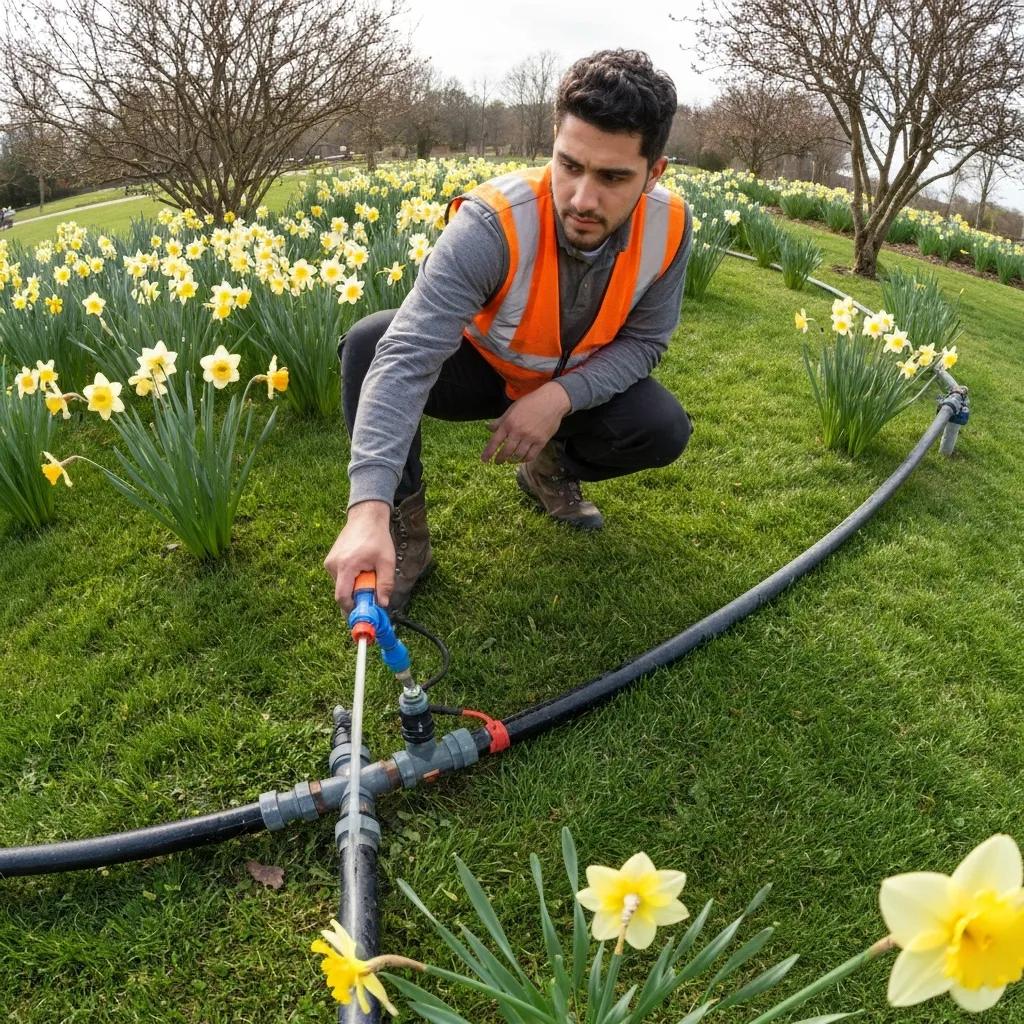
Seasonal maintenance organizes inspections and tasks around climatic cycles—typically spring startup, summer optimization, fall adjustments, and winterization—so systems perform correctly year-round while minimizing freeze or drought risks. At each seasonal checkpoint, technicians should perform zone tests, evaluate controller schedules against evapotranspiration patterns, check pressure and flow, inspect heads and valves, and verify backflow devices. Systematic seasonal procedures prevent compounding failures and make it easier to identify trends like steadily rising leak frequency or declining flow that indicate larger problems. Below is an actionable seasonal table that maps core steps to seasons and provides a succinct checklist for facilities teams and contractors.
Below are the specific step-by-step procedures for a spring startup and a winterization that teams can apply.
What Are the Essential Steps in a Spring Startup Checklist?
A spring startup prepares a commercial irrigation system for the irrigation season by verifying hydraulics, correcting coverage, and programming seasonal schedules that reflect plant needs and local climate. The checklist begins with a comprehensive visual inspection of visible heads, valve boxes, and lateral lines to find damage or rodent/root interference. Next, conduct a zone-by-zone flow and pressure test while running each zone to identify clogs, misaligned nozzles, or pressure issues; adjust nozzles and replace damaged heads as needed. Finally, reprogram the controller with current seasonal evapotranspiration data or baselines, set correct daily run times and cycle-soak patterns to prevent runoff, and log the startup results for trend tracking.
Tools required include a pressure gauge, flow meter or bucket, screwdriver set for nozzle swaps, and the controller manual or diagnostic interface. These steps reduce early-season plant stress and minimize water waste.
How Should You Winterize a Commercial Irrigation System to Prevent Damage?
Winterization prevents freeze damage in climates with cold temperatures by removing water from the system and protecting susceptible components like backflow preventers and above-ground valves. The most controlled method for large systems is a professional air blowout: upstream valves are shut, and each zone is purged with compressed air at recommended pressures while monitoring downstream devices. Insulate or remove backflow preventers and use licensed testers if regulations require; add valve box insulation where practical and slope exposed lines if possible to reduce standing water. For properties in marginal-freeze zones, reducing schedules and installing freeze sensors on controllers can prevent automatic runs during cold snaps.
Because improper blowout pressures can damage pipes and emitters, many property managers opt for professional winterization services for large systems; the next section explains common problems and diagnostics that can prompt professional calls.
What Are Common Commercial Irrigation System Problems and How Can You Troubleshoot Them?
Commercial irrigation systems commonly experience leaks, clogged nozzles, pressure imbalances, electrical/controller faults, and backflow device failures; systematic troubleshooting isolates the causal domain quickly. Start by distinguishing hydraulic problems (loss of pressure or flow), mechanical problems (broken heads, damaged pipes), and electrical faults (controller/program errors, solenoid failures). Use pressure and flow testing to detect hidden leaks, visual inspections and catch-basin checks for surface saturation, and voltage/resistance testing for electrical components. The following problem→fix list provides concise diagnostic actions that technicians can follow during routine maintenance or emergency response.
- Leak — Inspect lateral line surfaces and measure system pressure; excavate and repair couplings or replace damaged pipe sections.
- Clogged Nozzles — Remove and clean nozzles or replace with correct-flow nozzles to restore spray pattern and uniformity.
- Low Pressure — Check for stuck valves, partially closed mains, or concurrent high-demand fixtures; isolate zones and test valve actuations.
- Controller Faults — Verify transformer voltage, check program schedules and seasonal adjustments, and inspect wiring connections for corrosion.
How Can You Detect and Repair Leaks in Commercial Sprinkler Systems?
Detecting leaks combines visual inspection, pressure and flow monitoring, and acoustic or tracer methods to locate hidden failures in mains or laterals. Begin with a baseline pressure/flow test: compare expected flow for each zone to measured values while the zone is operating; a sustained pressure drop or elevated flow indicates a leak. Visually scan irrigated areas for unusually lush growth, muddy pockets, or depressions; use acoustic listening devices or ground-penetrating tracer dyes for subsurface lines when visual cues are absent. Repair methods vary from simple coupling replacements and patching to excavating and replacing mainline sections; use appropriate sleeve or repair couplings rated for system pressure and backfill carefully to avoid future settling.
After repair, re-test pressure and flow to confirm restoration and document the repair location and cause for trend analysis during future inspections.
What Are Typical Controller and Valve Issues and Their Fixes?
Controller and valve issues commonly include mis-programmed schedules, transformer or power failures, corroded wiring, and solenoid or diaphragm degradation within valves. Diagnose controllers by confirming incoming transformer voltage, checking for correct program date/time and seasonal adjustments, and validating remote connectivity if applicable; a factory reset may be necessary after verifying backup configurations. For valves, measure solenoid resistance with a multimeter to check for open or shorted coils, inspect valve bodies for debris or seat wear, and replace diaphragms or solenoids as first-line repairs. In many cases, replacing the valve or controller module is more cost-effective when repeated failures occur due to age or environmental corrosion.
When electrical faults or complex manifold wiring issues are suspected, follow safety protocols and consider professional electrical technicians to avoid damage or safety hazards.
How Can Smart Commercial Irrigation Solutions Enhance Efficiency and Water Conservation?
Smart commercial irrigation solutions—weather-based controllers, soil moisture sensors, and flow-based anomaly detection—optimize runtime by aligning water application with actual plant needs and prevailing environmental conditions. Weather-based controllers integrate forecast or local weather station data to reduce runtimes during rainy periods, while soil moisture sensors provide direct feedback that prevents unnecessary cycles. Flow sensors detect unusual consumption spikes indicative of leaks or vandalism and can trigger alerts or automatic shutoffs, reducing waste and repair costs. Together these technologies create feedback loops where data informs scheduling, which in turn reduces water usage and lowers operational costs.
Adopting smart solutions also changes maintenance priorities: technicians shift from fixed-schedule checks to data-driven interventions, focusing on anomalies and sensor calibration to preserve accuracy.
What Are the Benefits of Smart Irrigation Controllers and Sensors?
Smart irrigation controllers and sensors deliver measurable water savings, remote management capability, and improved landscape outcomes by using real-time inputs to adjust runtimes and cycles automatically. Industry studies and vendor data typically report water savings in the 20–40% range when smart controllers are combined with proper zoning and sensor inputs; savings vary by climate, plant mix, and baseline practices. Remote connectivity enables schedule adjustments across multiple sites without travel, reducing labor costs and enabling rapid response to leaks or freeze events. Additionally, flow and moisture sensors reduce the need for conservative safety runtimes by providing direct measurements of soil conditions and system performance.
These benefits create clear KPI opportunities—reduced water usage per square foot and fewer emergency service calls—that justify phased upgrade decisions.
How Do Weather-Based Systems Automate and Optimize Water Usage?
Weather-based systems use forecast data, on-site weather stations, or local ET (evapotranspiration) inputs to calculate daily irrigation requirements and adjust schedules accordingly, reducing unnecessary watering during cool, cloudy, or rainy periods. Algorithms convert weather inputs into percent adjustments of baseline runtimes; for example, a rainy forecast may reduce daily runtime by a significant fraction, while hot, dry forecasts increase runtimes to meet plant demand. Integration with soil moisture sensors refines these adjustments by validating that applied water levels match plant-available moisture thresholds. While these systems significantly reduce water waste, they require correct configuration, sensor calibration, and periodic validation to avoid under-watering during microclimate anomalies.
Understanding these limits supports a phased retrofit strategy where critical zones receive sensors first and controllers are expanded based on measured ROI.
What Water Conservation Strategies Are Best for Commercial Irrigation Systems?
Effective water conservation combines hardware upgrades, smarter scheduling, and landscape-level decisions to lower usage while maintaining plant health. Key strategies include pressure regulation to reduce misting and runoff, strategic zoning to match plant water needs, converting appropriate areas from spray to drip irrigation for targeted delivery, and selecting native or drought-tolerant plant palettes to reduce seasonal demand. Metering and flow monitoring provide visibility into consumption and detect inefficiencies early, while seasonal tuning and soil-moisture-based scheduling ensure water is applied when plants actually need it. These approaches create a resilient water-management program that reduces costs and supports sustainability goals.
The following list summarizes practical conservation strategies that facilities teams can prioritize and implement incrementally.
- Implement pressure regulation and verify proper nozzle selection to reduce misting and drift.
- Retrofit high-volume spray areas to drip irrigation where plantings allow to cut evaporation and overspray.
- Divide landscapes into smaller, plant-matching zones to avoid overwatering sensitive or drought-tolerant sections.
- Install flow meters and anomaly detection to catch leaks early and measure the effect of conservation measures.
How Does Zoning and Drip Irrigation Save Water on Commercial Properties?
Zoning segments a landscape into areas with similar plant water needs so that each zone receives a tailored irrigation schedule; this matching minimizes overwatering and reduces run-to-run variability. Drip irrigation delivers water at the root zone with minimal evaporation or wind loss, making it ideal for planter beds, hedges, and tree rings where targeted application reduces total usage significantly compared with overhead spray. Example conversions show drip systems commonly reduce water use in planted beds by 30–50% depending on plant density and baseline practices. Designing zones with proper pressure regulation, matched-flow emitters, and separate schedules for turf and non-turf areas is the most effective way to realize these savings.
Well-designed zoning reduces stress on controllers and makes sensor placement and automation more effective across a property.
Why Are Native Plants Important for Sustainable Commercial Landscapes?
Native and drought-tolerant plants reduce irrigation demand because they are adapted to local climate conditions and seasonal rainfall patterns, requiring fewer supplemental waterings once established. Using native palettes lowers maintenance needs, reduces fertilizer and pesticide dependencies, and creates landscapes resilient to climate variability. Sourcing appropriate local cultivars and planning for establishment-phase irrigation followed by reduced summer maintenance are key to realizing long-term water savings. Incorporating native plants into a comprehensive irrigation strategy yields operational efficiencies—fewer run hours, lower wear on components, and reduced overall landscape management costs.
Selecting plant palettes should be coordinated with irrigation design so zone assignments reflect actual plant water categories and establishment requirements.
When Should You Call a Professional for Commercial Irrigation System Maintenance and Repairs?
Call a professional when the scope or risk of repairs exceeds on-site capabilities—examples include mainline excavation, complex manifold replacement, electrical network faults across multiple controllers, or backflow testing required by municipal code. Professional technicians bring diagnostic tools, trenching and pipe-repair equipment, certified backflow testing capability, and experience with system-wide hydraulics that are necessary for safe and long-lasting repairs. For large commercial systems, professionals can also provide scheduled inspection programs, documentation for regulatory compliance, and data-driven recommendations for smart upgrades with clear ROI calculations. Deciding when to escalate prevents small issues from becoming costly projects and ensures compliance with local safety and water-use regulations.
What Complex Repairs Require Expert Intervention?
Major mainline replacements, manifold and valve bank excavations, complex electrical controller networks, and repeated backflow device failures generally require professional intervention due to safety, code, and warranty considerations. Excavating mains often involves utility locating, trench shoring, and precision pipe fusion or solvent welding that prevents future leaks; incorrect repairs can lead to recurring failures and increased lifecycle costs. Electrical networks controlling multiple controllers or remote satellite valves may need licensed electricians to diagnose transformer or power distribution issues safely. Professional backflow testing and certification are typically required by municipalities and should be performed by certified technicians with appropriate documentation.
Entrusting these repairs to experienced teams reduces liability and preserves system integrity over the long term, which is why many property managers include professional services in their maintenance plans.
After complex repairs are defined and scheduled, property teams should also establish inspection cadences that ensure recurring problems are caught early; the next subsection recommends inspection frequency and coverage items.
How Often Should Annual Inspections and Maintenance Be Scheduled?
A recommended inspection cadence for most commercial properties includes quarterly visual checks, a spring startup and fall adjustment, and an annual full-system inspection that includes backflow testing and flow/pressure audits.
Quarterly visual checks catch surface leaks, vandalism, and obvious mechanical failures.
The annual full inspection should measure system flow rates across zones, test backflow assemblies (if required locally), verify controller programming and seasonal adjustments, and document component wear for lifecycle planning.
Properties in freeze-prone areas may need additional pre-winter checks and post-winter startup verifications; high-use or high-visibility landscapes can benefit from monthly visual audits during peak season.
How Much Does Commercial Irrigation System Maintenance Cost and What Factors Affect Pricing?
Commercial irrigation maintenance costs vary widely based on system size, accessibility, component age, local labor rates, required certifications (e.g., backflow testing), and the scope of seasonal services and upgrades. Typical cost drivers include the number of zones, total irrigated area, the presence of complex controllers or remote telemetry, and whether repairs require excavation or lane closures. Bundled seasonal maintenance packages offered by professional vendors often include spring startup, periodic inspections, fall shutdown, and backflow testing—this bundling reduces per-visit costs and simplifies budgeting. Below is a cost-driver table that presents typical cost categories, example ranges, and factors that influence price, helping decision-makers set realistic expectations.
These ranges are illustrative; request site-specific quotes to capture local labor rates, access constraints, and device counts accurately.
Professional vendors—including those with backgrounds in property services—commonly offer bundled seasonal maintenance and inspection packages that smooth cash flow and simplify compliance tracking. For example, vendors can combine spring startup, quarterly audits, annual backflow testing, and emergency response into a single annual contract, which often reduces per-visit costs and centralizes documentation. When comparing quotes, evaluate whether the package includes labor, parts, warranty terms on replaced components, and clear response-time commitments, as these features materially affect lifecycle costs and return on upgrades.
What Are Typical Costs for Seasonal Maintenance and Repairs?
Seasonal maintenance costs typically cover the labor and basic materials for startup and shutdown procedures, head adjustments, minor head/solenoid replacements, and controller reprogramming. Small sites may pay on the lower end per visit, while large campuses with many zones and complex controllers push costs higher. Repair examples: a single sprinkler head replacement with labor may be a modest line item, while mainline repairs that require excavation and paving restoration can escalate into multi-thousand-dollar projects. Planning for predictable annual maintenance and a reserve for larger repairs reduces emergency contracting premiums and keeps systems reliable.
How Do Smart System Upgrades Impact Overall Maintenance Expenses?
Smart upgrades typically require higher initial investment for controllers, sensors, and integration yet reduce ongoing maintenance through automated scheduling and anomaly detection. Upfront costs include controller procurement, sensor installation, and possible rewiring; ongoing costs may include telemetry or data-subscription fees in some systems. Over time, water savings, reduced manual labor, and fewer emergency repairs tend to offset the initial expense, with typical payback periods ranging from two to five years in many commercial contexts depending on scale and water pricing. Phased implementations and vendor-supported analytics help validate savings and refine program expectations.
With quantified savings and clear service agreements, smart upgrades become a predictable element of long-term water management and capital planning.
Brightwater Irrigation and Lighting offers Commercial Cleaning Services and is available for consultations and quotes.


